
American manufacturing · A supplier guide
The U.S. Factories Behind Apple’s Supply Chain
Titanium in Pennsylvania. Glass in Kentucky. Chips in Arizona. A guide to seven suppliers, what they make and where their companies began.
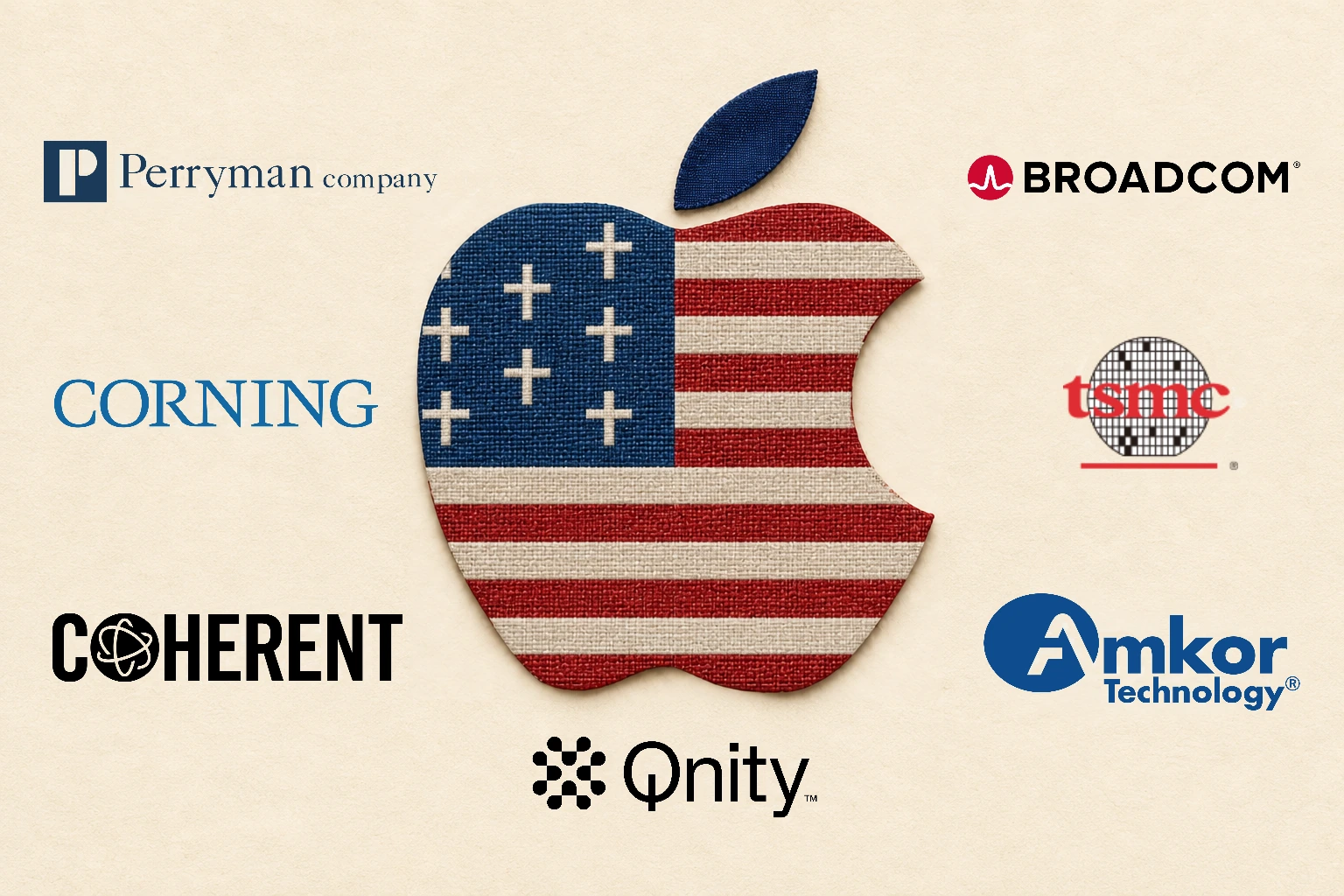
Apple and the Apple logo are trademarks of Apple Inc. This independent article and illustration are not sponsored or endorsed by Apple or the companies shown.
October 20 announcement
Before it becomes
a phone.
A phone’s supply chain includes work that looks nothing like a phone: metal melting in a furnace, glass being formed and tiny lasers being manufactured. Apple’s latest supplier announcement puts Pennsylvania titanium producer Perryman and camera-materials maker Qnity Electronics among the companies doing that work.
In its October 20 announcement, Apple highlighted seven suppliers and said nearly 100 components across iPhone Duo and iPhone 18 Pro come from companies supplying it from more than a dozen states.
Those seven names tell several different stories. Some businesses began in the United States; others have international corporate histories. Some factories are producing today, while another is still being built. Here is what the companies disclose—and what the announcement leaves unanswered.
Six locations · Five states
Where the work happens
Six disclosed U.S. locations
Choose a number or a company to see what it makes and whether the site is operating.
- Operating site
- Under construction
- PerrymanHouston, Pennsylvania
- CorningHarrodsburg, Kentucky
- CoherentSherman, Texas
- BroadcomFort Collins, Colorado
- TSMCPhoenix, Arizona
- AmkorPeoria, Arizona · Under construction
Not on the map: Qnity Electronics. Apple names its Delaware headquarters, but does not identify its film-production factory.
Six disclosed city locations from seven named suppliers. This is not a map of every component or a classification of company ownership. Geography: Natural Earth. City points: U.S. Census Bureau, 2025.
The complete named list
Seven suppliers.
Seven company histories.
What they make, where the work happens, and how each business began.
Titanium
Perryman
Houston, Pennsylvania
Titanium · Operating. Apple says Perryman melts, forges and rolls titanium for iPhone Duo, with at least 80% recycled content. Apple’s commitment is up to $100 million over three years.
Company roots: Perryman dates its founding to 1988. Its timeline records construction of a Houston, Pennsylvania, factory the following year. That establishes an early Pennsylvania operation; the timeline does not specify where the company was first formed. Its manufacturing history includes expanding from titanium processing into finished parts.
Cover glass
Corning
Harrodsburg, Kentucky
Cover glass · Operating, with expansion. Corning’s Harrodsburg plant makes protective glass for phones. Apple says it will produce all worldwide iPhone and Apple Watch cover glass by the end of 2026; that remains a target.
Company roots: Corning’s history begins in Massachusetts in 1851. The business later moved to Corning, New York. Its American origins long predate the smartphone: this is an established glassmaker supplying a newer industry.
Sensing lasers
Coherent
Sherman, Texas
Lasers for sensing · Operating. Coherent makes miniature semiconductor lasers used in Face ID and other sensing features. The company’s Apple partnership announcement identifies Sherman as a manufacturing site for these components.
Company roots: Today’s Coherent traces its founding to II-VI in Saxonburg, Pennsylvania, in 1971. II-VI adopted the Coherent name after an acquisition in 2022. The current name and the founding date therefore come from different points in the company’s history.
Wireless components
Broadcom
Fort Collins, Colorado
Wireless components · Operating, with expansion. Broadcom’s 2026 filing identifies Fort Collins as a manufacturing site for filters used in wireless communications. Such filters separate the signals a device needs from unwanted frequencies. Apple’s announced expansion agreement covers several product lines.
Company roots: The original Broadcom incorporated in California in 1991. Singapore-incorporated Avago acquired it in 2016 and adopted the Broadcom name. The parent moved its legal home from Singapore to Delaware in 2018. A simple American-founded label would leave out that corporate history.
Semiconductors
TSMC
Phoenix, Arizona
Chips · Operating, with expansion. Taiwan Semiconductor Manufacturing Company, or TSMC, manufactures chips for other companies. Its first Phoenix factory entered high-volume production in late 2024. Apple’s announcement describes Arizona chips used across several of its product lines.
Company roots: TSMC began in Taiwan in 1987. TSMC Arizona is its wholly owned U.S. subsidiary. A chip made in Arizona is evidence of manufacturing in the United States. It does not make the parent company American-founded.
Chip packaging & testing
Amkor
Peoria, Arizona
Chip packaging and testing · Under construction. Amkor’s Peoria project concerns work after chips are manufactured. Packaging connects and protects a chip so it can be used in a device; testing checks that it works. Apple is a future customer. This plant is not yet a source of parts already shipping.
Company roots: Amkor’s history connects a U.S. sales business with Korean manufacturing. Its timeline places James Kim’s founding of Amkor Electronics and the opening of a Philadelphia sales office in 1968. Its manufacturing roots include Korea’s ANAM. Both belong in the account of where the company began.
Camera films
Qnity Electronics
Factory location undisclosed
Camera films · Announced production. Apple says Qnity will make films for iPhone 18 Pro’s variable-aperture camera, which adjusts the opening that admits light. The release names Qnity’s Delaware headquarters, not the factory.
Company roots: Qnity became an independent company through DuPont’s electronics-business spin-off in November 2025. Its legal entity was formed in Delaware in 2024; the business it inherited is older.
Reading an origin claim
Does this make the iPhone
Made in USA?
Where it began
Founding records establish a company’s history.
Where work happens
A U.S. plant establishes the location of that manufacturing work.
Where it is made
The full product’s components, processing and final assembly must be considered.
The announcement does not establish that. Under the Federal Trade Commission’s standard, an unqualified Made in USA claim requires U.S. final assembly or processing, all significant processing here, and all or virtually all materials and components made and sourced here. Foreign content must be negligible.
A component count cannot answer all those questions. Apple has not supplied a complete parts list or a domestic-content percentage in this release. We cannot turn “nearly 100” into a share of each phone’s materials, cost or manufacturing work. Nor does the announcement establish the origin of every supplier’s inputs.
Company origins and product origins are separate questions. Founding records tell us where a business began, not the origin of everything it makes. This guide covers the seven named suppliers; it is not an independent factory audit or a complete inventory of Apple’s suppliers.
The Americana Gecko Take
Give the Factories Credit. Be Exact About Origin.
We want more of the work behind everyday technology done in the United States. A factory that melts metal, makes glass or produces chips gives us something concrete to examine: the work performed there, the people doing it and the orders that keep production going.
American-founded companies deserve recognition for what they have built here. That history matters to Americana Gecko. We also recognize the work done in U.S. plants owned by companies founded elsewhere, while identifying those companies accurately. Calling TSMC Taiwanese does not erase its Arizona operation; calling that operation American does not change where TSMC began.
Apple could make its announcements more useful by publishing a model-by-model account of the parts, manufacturing sites and final assembly locations. Readers should be able to tell which work is happening now and which is promised.
Recognizing domestic manufacturing does not require stretching the meaning of Made in USA. The finished product deserves an honest description of where it comes from.
Sources
- Apple — October 20 supplier announcement
- Perryman — Company profile; Company timeline
- Corning — Harrodsburg plant; Company history
- Coherent — Apple partnership announcement; Company history and name change
- Broadcom — 2026 filing; 2012 filing; 2016 filing; 2018 redomiciliation announcement
- TSMC — Arizona operations; Company profile
- Amkor — Arizona project; Company history
- Qnity — DuPont separation announcement; Certificate of incorporation
- Federal Trade Commission — Complying with the Made in USA Standard
- Map sources — Natural Earth terms of use; U.S. Census Bureau Gazetteer files


